BLE tag enabling utilization tracking and localization for agricultural equipment
Utilization monitoring and localization of equipment are common challenges in agriculture. Our client wanted to reduce operational cost by acquiring actionable utilization data while supporting equipment location by staff. To address this we developed a custom BLE based asset tag. Our solution was based on a BGM220P facilitating certification and asset localization. Utilization tracking was realized by an on-board motion sensor tracking equipment vibrations. We delivered a fully functional tag and all associated design and firmware data. Commissioning was supported by our extensive documentation and onsite training ensuring familiarity and confidence with the new tags.
Our customer wanted to gain insight into the use of his agricultural assets to optimize maintenance costs. Additionally, he was facing the challenge of finding specific appliances scattered in his machine park. Two readily available solutions were evaluated and fell short in key areas. GPS modules provided suitable asset tracking capabilities but showed high power consumption limiting battery lifetime. In contrast, BLE beacons offered a sufficient battery lifetime and asset tracking options yet failing to provide actionable asset utilization data. The first challenge was to identify a suitable method for sensing asset utilization. Monitoring a motion sensor promised a straightforward implementation with standard components. Moreover, on-board motion sensing has proven reliable in harsh condition as faced by automotive or aviation applications. In addition, the requested battery lifetime put constraints on power usage and associated computation time. Critically, any device had to endure rough outdoor conditions while fitting stringent form factor requirements. This warranted a custom full stack solution, integrating the stringent space requirements and special asset utilization tracking.
We were presented with two major challenges. Creating an asset utilization monitor with minute-level precision. Additionally, we were facing the challenge of asset localization when not in use.
The customer’s assets were heavy agricultural equipment used in agricultural operations. All assets exhibited significant vibrations when in use. These vibrations could easily be detected at the intended tag mounting point. Utilizing a motion sensor in our design enabled robust utilization detection. Selecting a sensor with a wake-up on motion feature facilitated our further design.
As for the localization challenge we decided to rely on BLE RSSI tracking. After comparing different platforms we settled for a BGM220P moduly by Silicon Labs. This module offers sufficient interfaces for peripheral electronics. Moreover it is FCC and EMI certified, which sped up development significantly. Connecting the motion sensor wake-up interrupt to the BGM220P allowed to keep active electronics in a low power state while the asset is in use. This allowed power saving schemes further extending battery life.
After solving utilization detection we implemented a BLE advertisement scheme to enable asset localization when not in use. An array of freely available BLE sniffer smartphone apps could then be used for asset localization. Utilization time data could be extracted by connecting with a dedicated anchor consisting of a standard Raspberry Pi 4. Once the asset is not in use we commence BLE advertising. The Raspberry Pi is scanning for valid BLE identifiers. If a valid identifier is discovered the Raspberry Pi connects to the tag and extracts all new asset utilization data.
We built our system on a simple prototype board. This prototype provided a twofold advantage. We were able to supply the customer with hardware for a successful proof of concept. Doing so further increased the customer’s confidence in our solution. Additionally, the prototype board allowed hardware in the loop testing of our final system.
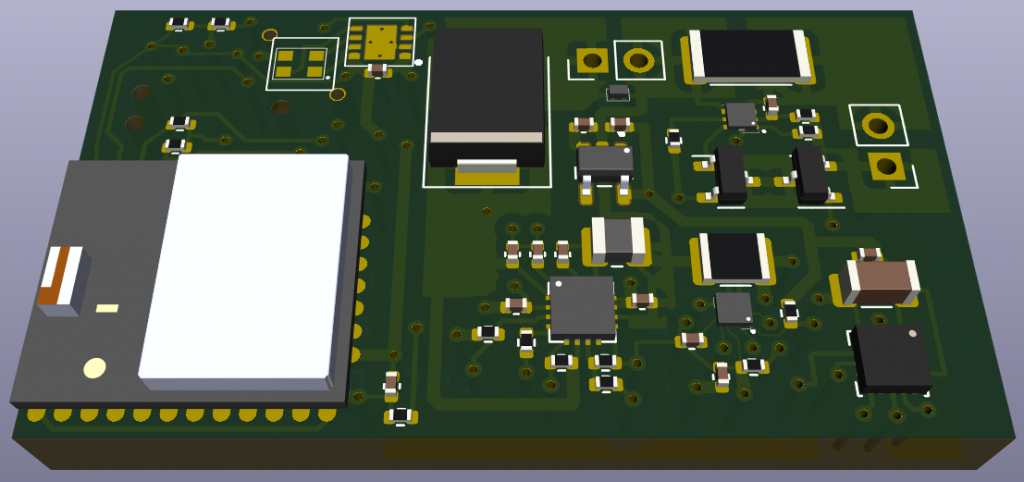
While the proof of concept was ongoing, we started developing all necessary periphery electronics. Selecting LiPo management components from Texas Instruments ensured easy compatibility and enabled a fast design cycle. Once all components were selected, we tackled the PCB design. Here we faced the tight spatial requirements imposed by our customer. Form factor compatibility was verified by CAD models.
Firmware development proceeded in parallel to our hardware development. Commencing from a simple BLE stack we first integrated drivers for all peripheral components. Initially focusing on asset utilization tracking and later advancing to asset localization and data retrieval. The final step of firmware development focused on battery management, minimizing power consumption and allowing robust user interaction.
We delivered the final product to the customer and supported initial commissioning. Our system integration was supported by on-site training for all employees. All hardware design files and firmware source code was provided as well, supplemented by extensive documentation.
We developed a custom form-factor BLE tag tailored to our customer’s asset tracking needs. At the tag’s core is a BGM220P BLE module by Silicon Labs. This module provides necessary FCC and EMI certification, and a robust platform for our custom BLE integration. Moreover the BGM220P offers rich peripheral interfaces enabling easy integration with additional electronics. A single cell LiPo battery powers the tag. As per the customer’s request, we designed a full charging circuit. This integrates battery protection, charging and monitoring. A two-pole magnetic connector allows easy charging with any sufficiently powered 5V supply. BLE is the backbone of our asset tracking solution. It is fully managed by our custom firmware. The customer’s special demand for asset utilization tracking was realized by an on-board motion sensor. Furthermore, we implemented a battery status report via BLE. When charging the tag uses an LED indicator to signal when the battery is full. We doubled the battery lifetime by utilizing the tag’s motion sensor for power-saving algorithms. All hardware development files and firmware source code was delivered to the customer. This was supplemented by extensive documentation and on-site training for all employees.
Leave a Reply